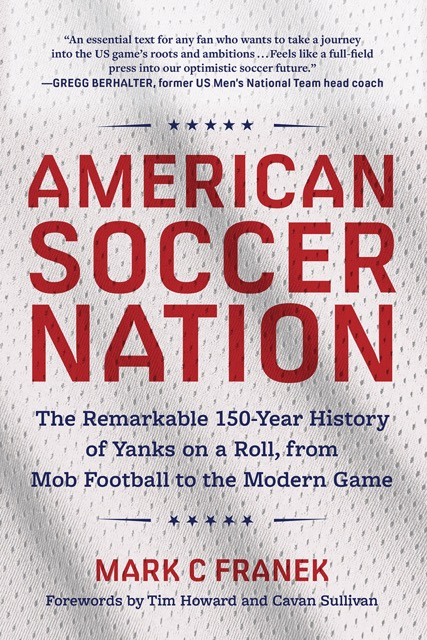

“In time for the World Cup and America’s 250th anniversary, American Soccer Nation: The Remarkable 150-Year History of Yanks on a Roll, from Mob Football to the Modern Game”
A sportswriter, educator, and former attorney who traded marble floors for greener pastures, Mark has written extensively on sports and human-interest topics for major publications.
He currently teaches at YSC Academy, the independent high school embedded within the Philadelphia Union, a team in Major League Soccer (MLS). There, he developed a course on the history of elite men’s soccer in the United States.
Rmag asked Mark to share his thoughts and findings on a sport that has enjoyed deeper roots on this side of the Atlantic than most of us might expect.
What inspired you to write ‘American Soccer Nation’?
YSC Academy’s Head of School asked me to design a course on the history of elite men’s soccer in the U.S. After reading a score of books on the subject and trying to teach them to my elite soccer student-athletes, the boys pushed back, calling the texts dull and negative.
So, I set out to write my own account, aiming to tell a positive, foundational story of 150 years of Americans playing the beautiful game on home soil.
Who were your most valuable interviewees?
I interviewed more than 50 people for the book, from top soccer figures to youth players on the verge of turning professional—spanning generations and roles across the game.
My three favorite conversations were with legends Tim Howard and Cobi Jones, and rising phenom Cavan Sullivan. Together, with many others, their stories underscored central themes of the book: In the growing American soccer landscape, everyone is connected, and we all want to get better and win.
What surprised you most when you dug into the topic?
One thing that surprised me during the writing was how the game of soccer in this country has always supported a pretty wide and diverse tent in terms of ethnicity, race, and socioeconomics.
The tent has always been more inclusive than the tents that support the other big 4 north American team sports. I also discovered that the sport of soccer is really a metaphor for living and developing winning habits of mind.
I’m sure others have written about it: How wonderful it is that nothing really ambitious and big happens without teamwork, and yet—and yet! —sometimes it’s the individual playmaker that creates the spark that makes a material difference to the final outcome.
Where did soccer first take root in America?
Soccer in the United States took its first tentative breaths on elite college campuses in the mid-1860s. Historians may quibble, noting those early contests were closer to proto-soccer.
In any case, the sport under the Laws of the Game—i.e., soccer, as codified in England in 1863—began to take clearer shape in the 1880s, gaining traction in immigrant communities across the country, especially in East Coast cities, on factory fields and vacant lots tied to the textile industry.
Soccer is nearly as old as baseball in the U.S. And its fits and starts, and now steady gains, evolved over a remarkable 150-year period.
Who was the country’s first soccer star?
The country’s first bona fide soccer star was probably Archie Stark, a Scot who emigrated to the United States as a teenager. He settled in New Jersey, served in World War I, then signed with a series of professional clubs in the American Soccer League, the nation’s first sustained pro circuit.
The league thrived for about a decade and was on its way to putting America on the international map before the Great Depression. Stark scored a remarkable 67 goals in the 1924–25 season, still the highest single-season tally in U.S. professional soccer history. By 1925, Stark was among the best players in the world.
Why did it take so long for the sport to grow in America?
There are many reasons. The story arguably begins in the 1870s, when East Coast colleges embraced proto-gridiron rules instead of the Laws of the Game.
Infighting also proved a constant obstacle, as early owners, administrators, and even the United States Soccer Federation focused on short-term gains rather than a long-term strategy for growing the sport across a vast country.
By the 1960s, the other three major team sports had already secured lucrative TV deals, while soccer lagged well behind into the 21st century. But MLS—now in its 30th season—is showing clear signs of growth, stability, and financial strength.
What role did foreign players have in making the game more popular here?
Global soccer superstars like Pelé, David Beckham, and Lionel Messi have undoubtedly boosted the sport’s profile in the United States. Today, it’s a joy to see kids across the country running around in pink Inter Miami CF jerseys.
But soccer won’t fully flourish here until American players consistently reach the game’s highest tier—and that remains a work in progress, though some are getting close.
Why do American women consistently outperform the men on the international stage?
American women have won four FIFA Women’s World Cup titles (1991, 1999, 2015, and 2019), the most of any nation. For decades, the U.S. women’s game was miles ahead of other countries in terms of youth and early-career development.
The rise of Title IX in 1972 dramatically expanded women’s sports in schools and colleges, creating a large, highly competitive college soccer system that functioned as a de facto academy pipeline.
That structure produced a deep talent pool, intense competition, and a level of overall depth most countries could not match (until the rise of professional women’s leagues, mostly post-2010).
American men were not so lucky. Most soccer-loving countries had fully professional men’s pro leagues, operating 10 months out of the year, some for over a century, while the American men, at best, and for decades, had a few college games in the fall.
Among the Big 4—Football, Baseball, Basketball, Hockey—how big will soccer get?
MLS attendance already surpasses the NHL, and many small-market teams in MLB and the NBA when comparing regular-season crowds.
Twenty-five of MLS’s 30 clubs now play in intimate, soccer-specific stadiums, which has helped create strong atmospheres and consistent demand.
MLS has also locked in a 10-year, $2.5 billion media deal with Apple TV, signaling long-term commercial confidence in the league’s trajectory. The 2026 FIFA World Cup, which will be hosted in North America, is expected to provide another significant boost to the sport’s visibility and growth.
Over the next 15 years, it’s plausible that soccer could far surpass the NHL and challenge the attendance figures of all but the very top-market teams in MLB and the NBA, and maybe even surpass those leagues in certain metrics. I wouldn’t bet against the soccer Yanks.
Why should Americans follow MLS when they have easy TV access to the superior European Leagues?
Because Americans can easily do both. We all know passionate, engaged fans who watch four or five NFL, NBA, or MLB games a week.
American soccer fans often follow their closest MLS club, a Premier League team in England, and a UEFA Champions League match from Europe—and everyone (except maybe the spouse) is a happy camper. No one can reasonably dispute that soccer fandom in America is on a full-field press nationwide.
What should we expect from the U.S. National Team this summer at the World Cup?
A round of 16 appearance would be nice. Getting knocked out earlier would be a disappointment. Anything past the round of 16 would be glorious. No matter what happens, soccer will continue to grow in this country. Welcome to American Soccer Nation!
Mark Franek has also been featured in 10 podcasts, including the Museum of Sports Show, GP Soccer Podcast, Free Play FC, That’s So MLS, and Chasing the Game.